Stonemasonry is a creative and practical craft. At Moulton College, you will learn how to shape, carve and restore stone for both old and modern buildings. Our courses give you strong skills, expert guidance and real experience to help you start a career in Banker Masonry, restoration or conservation.
Moulton College is one of only a few places in England where you can study stonemasonry full time. This makes the course special and gives you training that is hard to find elsewhere.
The craft is essential for restoring historic buildings, but also for new homes, public spaces and modern designs.
Students come to the course from many backgrounds. Some enjoy art or design, some prefer hands on work, and others want a career change. Stonemasonry suits people who enjoy detail, solving problems, and making things by hand. It also helps to have stamina, because the work can be physical.
Our strong industry links give you chances that most colleges cannot offer. You can complete work experience at Exeter Cathedral, where you help with real conservation projects. You may also take part in national competitions like SkillBuild.
We also have a partnership with the Worshipful Company of Masons, which includes guest speakers to help you better understand the craft.
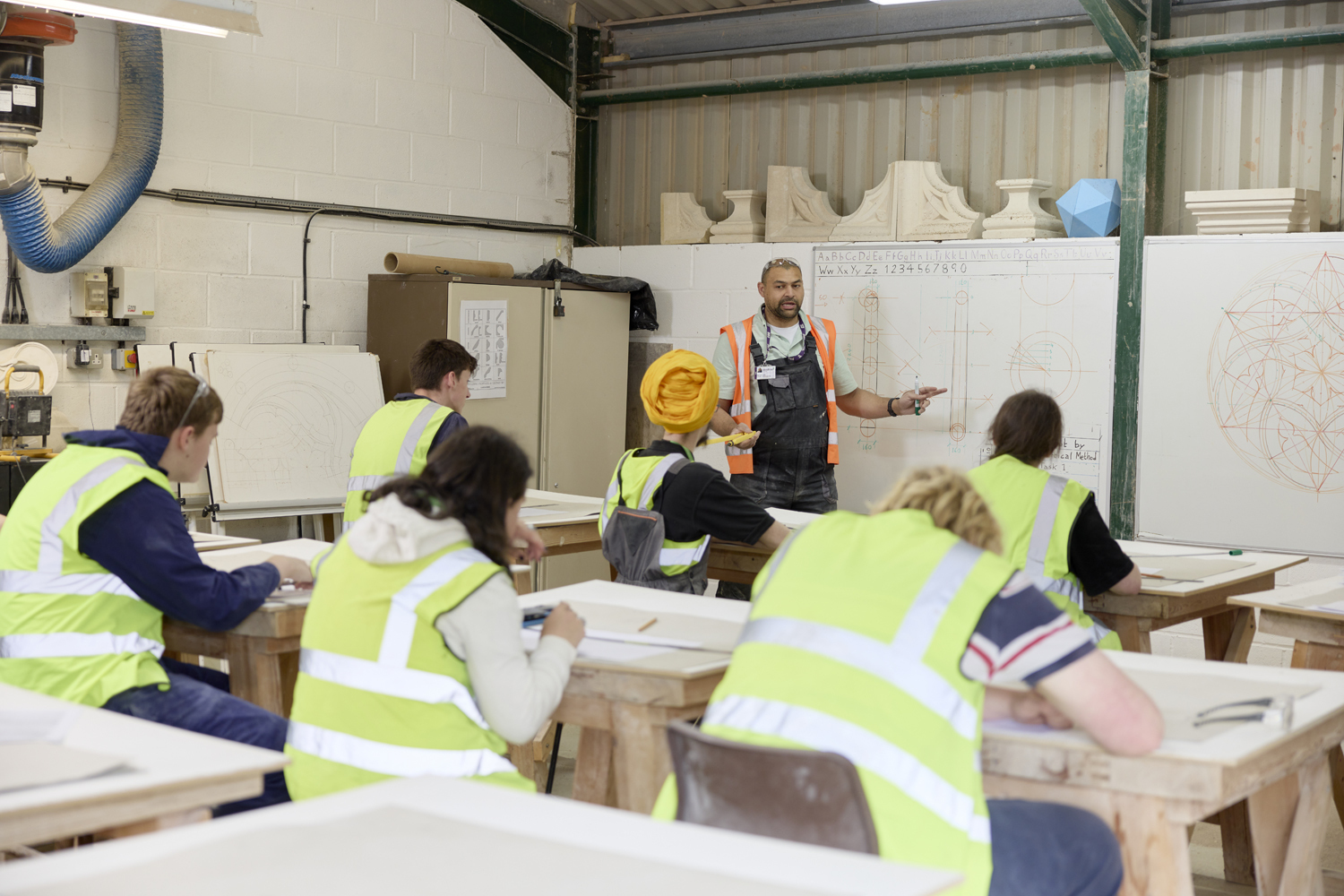
Training starts with the Level 2 Diploma, where you learn key skills in stone carving, banker masonry, letter cutting and restoration. You also learn technical drawing and geometry, which help you understand how stone pieces fit into buildings.
After Level 2, you can progress to the Level 3 Diploma and build more advanced skills for specialist work.
You can study full time or train as an apprentice. Both routes teach the same essential skills, but the experience is different:
Full time study
- Best if you enjoy structured lessons
- More time to practise skills in the workshop
- Includes heritage learning and detailed drawing tasks
- Work experience at Exeter Cathedral is part of the course
- Good for students who need more time to build confidence
Apprenticeship
- Level 2 apprenticeship available
- You work for an employer and attend college for training
- You earn while you learn
- A good option for students who prefer workplace learning
- Places can be limited so roles may be competitive
Careers
You can go on to roles such as banker mason, fixer mason and memorial mason. Some graduates work in heritage projects, modern construction or for national groups such as the National Trust. Others move into specialist carving or restoration.
Learning takes place in specialist stone workshops. You will handle natural stone and learn how to use chisels, mallets and other tools safely. Tasks include banker masonry, carving, letter cutting, fixing stone and shaping detailed pieces. You will also learn how to read drawings, set out templates and plan your work.
Lessons are split between practical workshops and classroom sessions. Theory lessons cover heritage skills, architecture, safety and conservation. You will also learn geometric drawing and some digital drawing (CAD) techniques. This mix prepares you for both traditional work and modern stonemasonry.
Students complete 40 hours of work experience, previous destinations have included Exeter Cathedral and the Kettering Cornerstone project, where you can test your skills on real buildings. Competitions and employer visits help you grow your confidence and understand the standards expected in the industry.
Assessment includes practical tests, written work, technical drawings, exams and coursework. This helps you prove both your craft skills and your understanding of the subject. By the end of the course, you will have the knowledge, experience and ability to move into work, take an apprenticeship or continue your training.
Have a question?
Have a look at our FAQs below to find out more.
Hear From Our Past and Current Students
See how students just like you turned ambition into achievement.

What course are you looking for?
Full time | Level 2
Diploma Level 2 Stonemasonry
Full time | Level 3
Diploma Level 3 Stonemasonry
Explore Your Future Career
Stonemasonry FAQs
Yes. As we are one of only four colleges in the country to teach stonemasonry full-time, we do attract students from further away. We offer accommodation on campus for students who live too far away to travel. Visit our accommodation page for more details.
Much of the course is hands on, but theory is important too and elements of our courses can be quite technical. You will study geometry, architectural terms and heritage topics. These help you understand how stone pieces are designed, and how they fit into real buildings.
The course suits students who enjoy making things, solving problems and working with detail. Many students come from art, DT or design backgrounds. You will need good focus and stamina, as the work can be physical. You do not need experience – just interest and commitment.
Full time students learn in college more often and spend extra time practising skills. They also take part in set work experience. Apprentices learn on the job with an employer and come to college for training. Full time is best if you want steady support; apprenticeships suit those who prefer to learn on the job while earning money.
Yes. Most students complete work experience at Exeter Cathedral, where you work on real restoration tasks. You may also meet employers and take part in competitions like SkillBuild to develop your skills.
You will train in specialist workshops equipped with a wide range of stoneworking tools and drawing spaces. These areas allow you to learn safely and work on real stone projects.
You can progress into roles such as banker mason, fixer Mason, memorial mason, stone carver, conservator or restoration specialist. Some graduates work with heritage organisations, others join modern building companies.
No. This is a full time professional course designed for people who want a career in stonemasonry. The learning is practical, technical and demanding. Mature students are welcome, but it is not a casual or evening class style course.