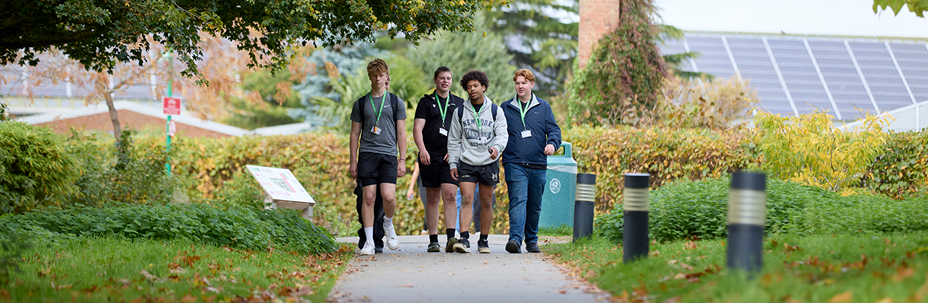
The UK has over 250 Further Education (FE) colleges, attended by more than 1.5 million students every year. These include FE colleges offering general education courses, sixth form colleges and specialist providers of subjects like the performing arts, art and design, or land-based studies.
Here we outline five things you might not know about further education, and why it continues to be such a popular choice for both young people and adults.
- Further education is an alternative to A Levels - it is not ‘less than’
Like A Levels, further education is a stepping stone into higher education or employment. Level 3 courses like T Levels are equivalent to three A Levels - they just offer a different and more practical approach to learning.
Unlike A Levels, which are classroom and subject-based, FE qualifications are vocational. They blend technical knowledge with practical skills, and are tailored to specific industries like construction, sport or animal care.
If you like to get hands-on with your studies, have a passion for a particular subject, or already have a career path in mind, FE offers a diverse range of options that will give you the launchpad you need. It is not the second-best option to A Levels – it is just another option for you post-16!
2. Further education is for everyone – whatever your age
FE colleges offer a vocational route for post-16 school leavers, with courses free for students aged 16-18. However, FE colleges are also a great option for adult learners, including those returning to education or who want to study part-time alongside employment, or people looking to gain the qualifications needed to pivot into an alternative career.
Whatever your everyday commitments, learning style or end goals, further education offers accessible options across a wide range of qualifications and different modes of study. From vocational diplomas in dog grooming to short courses in solar panel installation, take a look at your nearest FE college and see what is on offer today.
3. Further education gives you real-world experience from day one
Whichever qualification you choose, FE courses are designed to give you hands-on, real-world and career-focused experience from the get-go.
Many colleges have industry-standard facilities using sector-relevant equipment, tools or techniques. Those settings that offer hair and beauty will generally have an onsite salon, for example, while FE colleges delivering construction courses like bricklaying or carpentry will have workshops and equipment for you to hone your skills on. Alongside its leading construction, animal welfare and dedicated sports facilities, Moulton College is even home to a working farm, ideal if you are looking to study a land-based course!
What’s more, FE colleges have strong links with local employers who can offer work experience or taster days. Often, employers will work closely with FE colleges to shape the curriculum learned in college, too, which means your theory is up to date and industry-relevant.
4. FE courses give you work experience that helps your CV pop
Many FE courses include an element of work experience or industry placements. Combined with the sector-relevant knowledge and skills you gain at college, this will give you a real headstart when it comes to applying for jobs.
Work experience helps smooth the transition between education and employment as it gives you the chance to see what life is like in your chosen sector in a real-world environment. It also means you can build on skills employers look for, from teamwork and time management to communication and professional conduct.
The type and length of work experience you are expected to complete depends on your course, though it should take place with a sector-relevant employer. A T Level includes a mandatory 45-day industry placement, for example, while you could be asked to undertake 100+ hours of work experience over the length of your vocational diploma.
5. Further education doesn’t narrow your options
Choosing a vocational pathway doesn’t mean closing doors. Interests and career aspirations evolve, and further education helps you build a broad range of transferable skills that apply across many industries.
Employers often talk about ‘soft skills’. These are areas you are developing every day in further education and cementing through work experience or industry placements, like problem-solving, working independently or as part of a team. Many skills are also transferable and having a positive, can-do attitude can take you even further and into opportunities you may never have previously considered.
Further education is not a full stop; it is the pathway to an exciting future in employment, an apprenticeship, or university. If you are a bit stuck on what to do next, FE colleges like Moulton College also offer a careers service, which can help you make informed decisions about your next steps.